Church and Life
Volume LXXIV, Number 3
Happy Summer!
In anticipation of America's 250th Independence Day, this issue opens with the patriotic song "We Love our Land" by Holger Drachmann, which is regularly sung on Saint Hans Evening at Midsummer, and a translation of a patriotic speech by N.F.S. Grundtvig, calling his countrymen to remember the Danish constitution, to stand up for the sacredness of freedom, especially freedom of speech, and to support unity with other Nordic countries. Then, we dig into the archives for two pieces, the first a sermon published 70 years ago in the June 1956 issue of Kirke og Folk by Pastor Ebbe Juul. It is an eloquent call for everyday wonder at God's grace and a celebration of new beginnings. And the second, published 100 years ago in the June 10th 1926 issue of Den Danske Pioneer, is a brief nostalgic description of the ancient Danish city of Ribe in Southwest Jutland. Then we shift to contemporary issues with a report on the connections between culture and education. In early June, Professor Sally Anderson gave a lecture for the International House, Copenhagen, titled "Danish Pedagogy and Social Values." Brad Busbee gives an account of that lecture. And Nanja Holland Hansen, a psychologist, tells about her life-long experiences as a parent and student in the Danish folkeskole. In "Dateline Denmark," Edward Broadbridge explains the calculable value of trust in Danish society. Erik Hansen offers a compelling excerpt from A Contested Marriage, his novel-in-progress about the Danish emigrant experience. We close with two announcements, the first from the Danish Museum of America about Sank Hans Aften celebration on June 20th and the second from Anita Young about Danebod—and with a postscript by Brad Busbee, the editor.
The next issue of
Church and Life will be published in September (please see the Postscript for more information). For this issue, we would like to feature stories, commentaries, and memories from
you. Please send your stories (or any comment or question) directly to the editor at
mbusbee@samford.edu. Thank you to our readers, contributors, and supporters.
We Love our Land (Vi elsker vort land)
By Holger Drachmann (1885)
We love our land,
but at Midsummer most,
when every cloud above our fields
blesses the land with light.
When flowers bloom in full array,
and the nights grow shorter and bright,
we sing our song to Denmark—
our heart is warm with delight.
We love our land,
but at Midsummer most,
when every bird above the field
sings of things untold.
When gently blows the summer breeze,
and the ears of grain grow gold,
we stand together in joy and song,
our love for the land grows bold.
We love our land,
but at Midsummer most,
when bonfires shine by the coast,
and glow across the night.
Each burning flame speaks hope and cheer,
each spark becomes a light,
that warms our hearts and calls us home
in summer’s glowing night.
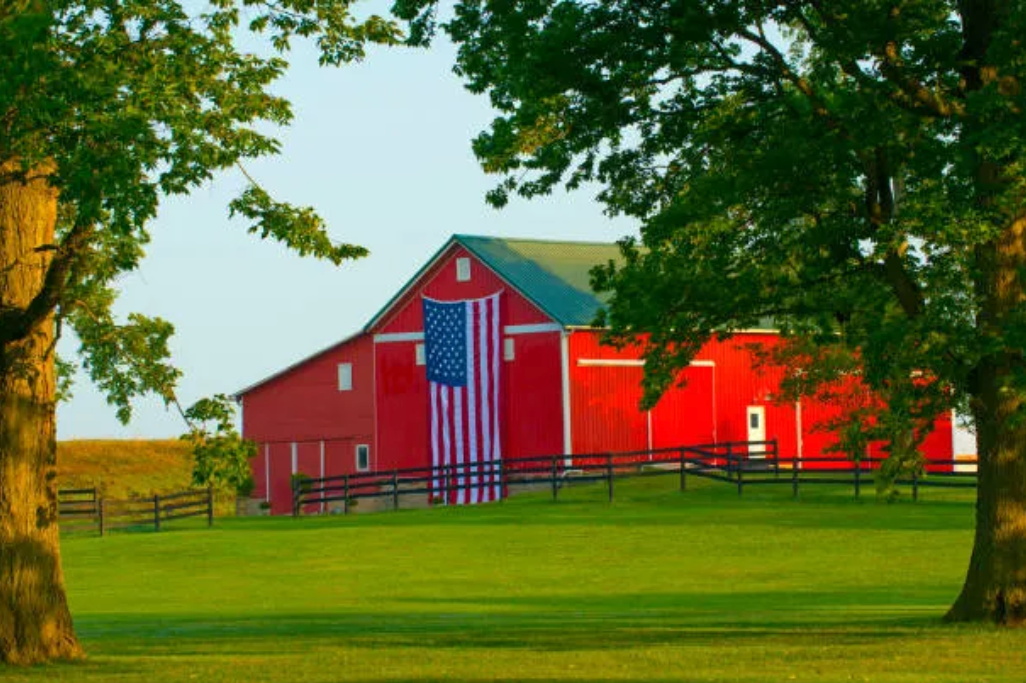
This is an abbreviated version of the song. It is also known as "Midsommervisen" (Midsummer song)—a popular Danish patriotic song at every Sankt Hans Aften celebration across the country.
The original version included music by P.E. Lange-Müller (1850-1926). In 1979, the Danish pop band “Shu-bi-dua” created a new melody for the song and, since then, both versions have been accepted and commonly used during Sankt Hans Aften celebrations among Danish communities.
Grundtvig's Constitution Day Speech at Tivoli
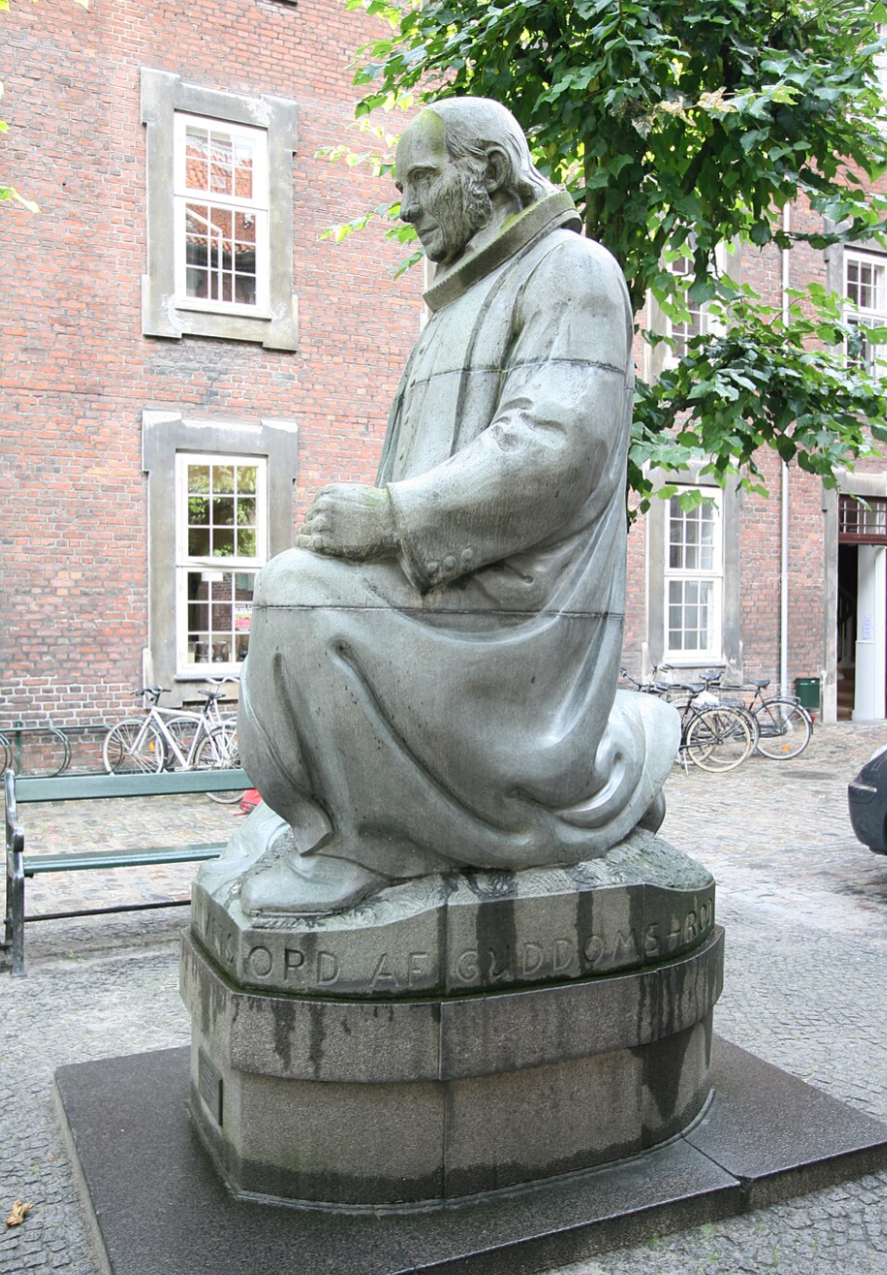
Grundtvig's 1857 Constitution Day speech requires some historical context to be appreciated.
In the mid‑19th century, rising nationalism was shaping Denmark—the idea that each people should form its own state based on shared language, culture, and identity. Denmark, however, was not a simple nation-state but a multi-ethnic monarchy. The Danish king ruled not only Denmark but also the duchies of Schleswig and Holstein along the shared southern border with Germany, where many inhabitants spoke German. At the same time, Denmark was developing into a constitutional monarchy with its 1849 constitution in place, while German nationalism was compelling German-speaking people to unite their regions into a separate state. Although the German-speaking regions were ruled by the Danish king, they were not fully integrated into Denmark. The result of these tensions is that, on the one hand, Danish nationalists wanted Schleswig tied more closely to Denmark to preserve a Danish-speaking state while, on the other hand, German nationalists argued that both Schleswig and Holstein should be united and incorporated into a German nation.
The conflict escalated into two wars. In the First Schleswig War (1848–1851), Denmark managed to retain control, but tensions remained unresolved. In the Second Schleswig War (1864), Denmark faced Prussia and Austria and suffered a decisive defeat, losing the regions in question: Schleswig, Holstein, and Lauenburg. This loss had a profound impact on Danish national identity and marked the end of Denmark as a significant regional power.
In the speech on June 5, 1857, Grundtvig addresses the tense historical moment in the years before the Second Schleswig War. He emphasizes the importance of preserving Denmark’s independence, language, and constitutional freedoms while warning against German influence. He also presents a Nordic union with other Scandinavian nations as a safe and natural alliance against German aggression. Overall, Grundtvig calls for unity during a time when the country’s identity was under serious threat, and he calls his countrymen to honor the constitution, the sacred right of freedom of speech, and the lessons of the Bible and history. These messages resonate today in democratic nations everywhere, even if they are not under direct military threat or do not, like the USA, have a national language.
* * *
Text of Grundtvig's Constitution Day Speech at Tivoli
We are gathered here to remember the Constitution of the Kingdom of Denmark, and we must declare our resolve to stand and struggle for it to the utmost—it certainly deserves that.
Yet we must by no means forget that here too the main matter is “The Kingdom of Denmark.” It is true that a kingdom can endure for many hundreds of years, and endure with honor, without having as good a constitution as ours. This much we should have learned from the history of Denmark, which also shows that whenever the Kingdom of Denmark truly sought a good constitution, it obtained one. However, all world history can and must teach us that even the very best constitution, when it loses its kingdom, can be abandoned. Then, the people are left searching, sometimes in vain, for a new one. Above all, it is clear that if the Constitution of the Kingdom of Denmark were to lose its kingdom and seek one within powerful Germany, it would be lost forever.
First and last, both for the sake of the constitution and for our own sake, we must hold fast to the Kingdom of Denmark to the utmost, we must remember the answers to these questions, ones many abroad and at home seem to have forgotten: First, where does the Kingdom of Denmark lie? Second, what language do the people of that kingdom speak? And third, what distinguishes Denmark's constitution from others?
Now, these questions seem easy to answer. But, for some reason, they are almost impossible for many who cannot even find Denmark on a map, the very country that needs to be defended.
For behold—Denmark lies, as has long been known, north of Germany; the language that the people of that kingdom speak with one another is Danish; and what makes Denmark’s constitution distinct from most others, and especially from the German states, is FREEDOM—freedom from which it has sprung and toward which it leads. Thus, even if we ourselves may be partly to blame that foreigners cannot clearly grasp the borders between Denmark and Germany, it remains just as certain that Denmark does not lie within Germany but north of it; and even if people in Denmark are very willing, not only within their ability but even beyond it, to speak all kinds of foreign languages, Danish nonetheless is and remains the language they speak, and must speak with one another in order to understand each other. Finally, though there may be some dispute about how liberal Denmark’s constitution is, we all know that the greatest human freedom—which we also exercise here in speaking plainly what we mean—is the freedom of word and speech, which is rare and does not exist at all in Germany. This freedom of speech is guaranteed to us by Denmark’s constitution.
Now that we have reflected on what sort of Kingdom of Denmark, with its constitution, we firmly intend to defend to the utmost, we must, at a time when all agree it is in danger; we must consider how best to defend it and where we might seek help if our own resources—what we have always called God’s help and our own—should not suffice. As no one can name any external support for Denmark other than one of two options—a German Confederation or a Nordic Union—I believe that for us there is nothing to choose between them. To seek help from the German Confederation, which does not at all wish Denmark to lie north of Germany, nor that the Danish people speak Danish, nor that constitutional freedom of speech should endure—that would be entirely wrong.
And when we hear from rumors, floating on east and south winds alike, that there is danger in turning to the German Confederation and that the danger of a Nordic Union would be far greater—that Denmark and the Danish people would be torn apart and never made whole again—I think those rumors are laughable. For one cannot become less than nothing: the Kingdom of Denmark would clearly be annihilated if it embraced the German Confederation.
Moreover, it is quite clear that if the three Nordic kingdoms entered into a union for their mutual benefit, they would be doing something very reasonable and would gain much from it, without it ever sensibly occurring to them to destroy one another. Strangely, though, some have asserted that a Nordic Union is a poetic idea, impracticable and therefore an impossibility.
I do not deny that a Nordic union for the common defense of the three Nordic kingdoms--and of all that is truly Nordic in spirit, language, and constitution--is a very poetic idea. Everything great, profound, and truthful is indeed poetic. But one doesn't have to be poetic to find the idea of a Nordic union practicable and beneficial; I can give no clearer proof of than what is written in our old rhymed chronicle, which some have accused of being very poetic, especially in the section dealing with the Kalmar Union, which was a Nordic union that lasted for a hundred years. Of this union, the poet says:
The cord that is laid of three strong strands
Will scarcely ever break,
So says the wise man without jest,
If it is woven gently. [Ecclesiastes 4:12]
And although the verses themselves are modest and the poetry hardly anything at all, they still show that in Denmark the Nordic union was considered both possible and desirable. And though I do not quite dare say with that old poet:
No force nor power in all the world
Can harm those kingdoms three,
So long as they remain bound
By the same agreement,
I can still confidently say that the cord formed gently from the three Nordic kingdoms would not easily break, and even one of the great powers would have difficulty snapping it.
I will therefore conclude, like the old rhymester:
Thus I advise all worthy men
Who are to defend those realms,
Knights and squires, each one—
Let them remain united!
Listen to no enemy’s counsel
That would advise you otherwise!
[These and the lines above are taken from the 15th century Danish Rhyme Chronicle, particularly sections dealing with Queen Margrete I and the Kalmar Union.]
For it stands crystal clear to me that only the enemies of all three kingdoms could advise us against the Nordic union, which in our eyes is the only salvation for the realm, the people, and all the North.
While I therefore have no wish for the German Confederation, except that we may rid ourselves of it as soon as possible, it is my heartfelt wish for the Nordic Union that, as we recently sang, the spirit of the sons of the North:
May itself bring forth anew a pact
That can endure!
Long live the reborn Nordic Union!
Beginning
By Pastor Ebbe Juul
[This sermon was originally published in Kirke og Folk, on June 25, 1956. It was translated by Brad Busbee]
(5th Sunday after Trinity)
The Gospel Reading: Luke 5:1–11
1. On one occasion, while the crowd was pressing in on him to hear the word of God, he was standing by the lake of Gennesaret, 2 and he saw two boats by the lake, but the fishermen had gone out of them and were washing their nets. 3. Getting into one of the boats, which was Simon’s, he asked him to put out a little from the land. And he sat down and taught the people from the boat. 4. And when he had finished speaking, he said to Simon, “Put out into the deep and let down your nets for a catch.” 5. And Simon answered, “Master, we toiled all night and took nothing! But at your word I will let down the nets.” 6. And when they had done this, they enclosed a large number of fish, and their nets were breaking. 7. They signaled to their partners in the other boat to come and help them. And they came and filled both the boats, so that they began to sink. 8. But when Simon Peter saw it, he fell down at Jesus’ knees, saying, “Depart from me, for I am a sinful man, O Lord.” 9. For he and all who were with him were astonished at the catch of fish that they had taken, 10. and so also were James and John, sons of Zebedee, who were partners with Simon. And Jesus said to Simon, “Do not be afraid; from now on you will be catching men.” 11. And when they had brought their boats to land, they left everything and followed him.
***
The message
After Peter has gone back to his ordinary work one more time at Jesus’ urging, he suddenly experiences something different: this time it actually leads to results. And in response to that, Peter says only one thing: “I am a sinful man.”
This is his entire reaction.
And that same thought appears in the day’s prayer: We are unworthy to receive all this. We acknowledge that is no real proportion between the one who receives and what is given—neither in scale nor in worthiness or merit.
That day—when everything suddenly turned out so overwhelmingly—must have been a turning point in Peter’s life. It was something he would remember again and again, something that remained vivid in his mind when he later spoke about the abundance of God’s grace.
The point is that God’s rich love is meant to be seen in all areas of life, especially in everyday work. Life is not meant to blur into one monotonous long stretch of labor where only a few moments stand out. Instead, every day must carry the possibility of being new—a true beginning—because each day brings its own calling.
But often we stop seeing things that way. Nothing feels surprising anymore. We get used to things—perhaps even to other people—and then life itself starts to feel flat. The sense of something new and joyful is gone, and we begin to look for liveliness somewhere outside ordinary life.
Christen Kold said that we must begin with the basics. For life to be real, it must be simple and straightforward. That is the nature of everything that comes from God.
In this sense, all work is new. It is not just a dull continuation of the same old routine—it always holds the possibility of a fresh beginning. When Jesus tells Simon to go out into the water, he does not say, “try again.” He is not appealing to stubborn persistence. Instead, his command is for something new in itself—like the sunrise, fresh and original each time.
What we are called to is not something grand or extraordinary. It is something simple and direct—just like everything that comes from God.
And yet, in another sense, it is extraordinary. Because it is precisely in our unworthiness that we meet what we have not earned: God’s gift—another day. A day that may seem plain and ordinary is surprisingly full of what is holy and meaningful.
So we begin again. And we become aware of our own unworthiness once more. The story of how things turn out well, through a new beginning, also reminds us that the “great fishing for people” is not over yet.
In Christ’s kingdom, people gather not only to meet again, but also to rediscover one another—to take hold of something living and to move together toward something good. If we learn to see life from this perspective, it becomes simple, clear, and true.
Other people are no longer just objects or obstacles in our lives. They become fellow travelers—people who help us take the first steps toward something whose final outcome we cannot yet see.
Amen
Lovely Denmark
[The following piece was published 10 June 1926 in Den Danske Pioneer, page 4. It was itself a reprinted from a newspaper article written by Aage Spodsberg for Aarhus Stiftstidende. What follows was translated and annotated by Brad Busbee.]
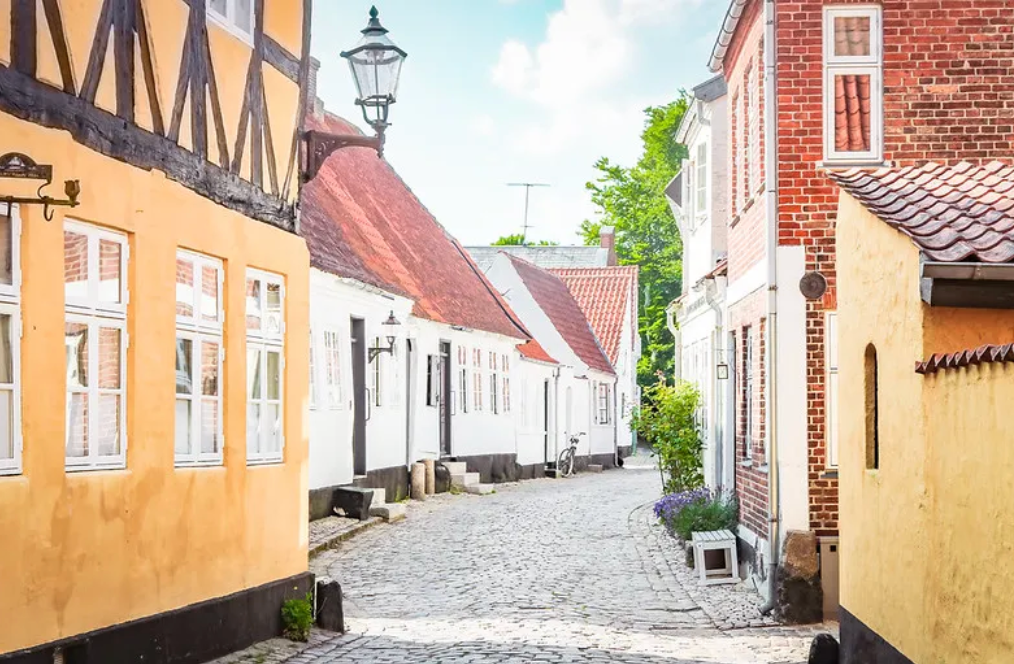
In Aarhus Stiftstidende, Aage Spodsberg writes the following: “Impressions from Ribe: The city of Memories” — an atmosphere that will surely awaken recollections among former residents of Ribe in the United States.
High above the misty meadows rises first the cathedral’s watchtower; then one sees the nave, and finally the Mary tower. There it lies — Our Lady in Ribe. Beneath the cathedral’s watchful gaze, small red‑tiled houses run in and out between one another. No two are built in the same way; none are of equal height, yet at first glance they all appear alike. Only when one looks more closely does one discover how different they are. Here the crossbeams are straight, there they are slanted — small details that nonetheless reveal the age of the houses.
In another way, the houses also tell their story. At every moment one is reminded that this is historic ground. Here Anders Vedel was stuffed with Latin; here lived the founder of Denmark’s first newspaper; and over there walked the hymn writer Brorson, searching for the most beautiful rose. In one place, an inscription tells of the witch Maren Spliid, who was burned as a practitioner of black magic. The whole Middle Ages, with its superstition and fear, comes vividly to life as one walks through Ribe’s streets with their countless cobblestones — where, in the summer months, the rhythm of life is marked by the time when the cows are driven home.
To the west, the rows of houses end abruptly and the marsh begins. There is no room for suburban gardens here — the marshland is far too valuable. The river winds gently toward the sea in a calm spiral, but farther out it becomes a dug canal, along whose clay banks one can see a full cross‑section of the marsh — from tall grass above to sand below. Then the sea dike rises, and beyond it the white, foaming crests of the North Sea shimmer in the setting sun. Even now, the people here carry a fear of the sea in their blood, and if one asks whether the dikes will hold, the answer is never entirely reassuring.
Look back for a moment: there lies Ribe, with the cathedral like Gulliver in the land of the Lilliputians. From out here, the castle mound also rises — the only remnant of the old Riberhus — above the low meadows, where the “moor‑wife” has already begun brewing, so that steam from her kettle drifts up and down across the flat land. On this mound Queen Dagmar once came ashore and brought peace to Denmark — peace that, even after seven hundred years, can still seem to be felt here.
In the quiet stillness, one calls to mind the image of Queen Dagmar, and another vision appears as well: Her grieving husband, who on that night rode through the dark heaths of Jutland to reach Ribe before she died. The foam‑covered horse rushes on, stumbling, nearly spent — but it must go on. Friends are long since left behind . . . and one almost hears again the horse’s hooves over Ribe Bridge.
The castle is gone now, and the bridge is no longer the same. People walk across it on peaceful summer evenings, leaving the town behind and heading out into the open countryside. And how easy it is, on such an evening in this tranquil place, to dream oneself back into the Middle Ages with all its romance. The cathedral bells send their soft tones out over the town, then fall silent. On summer evenings, all the red roofs lie like a bed of blooming, heavy roses — a reminder of beautiful peace, and of Queen Dagmar.
—Aage Spodsberg
Notes: Aarhus Stiftstidende was founded in 1794 by Niels Lund (mentioned later in the piece). It is one of the longest-running local/regional newspapers in Denmark. It is based in Aarhus (Århus), Denmark’s second-largest city. The name literally means “Aarhus Diocese Newspaper” (from “stift,” meaning a church district/diocese). Aage Spodsberg was a Danish journalist and writer who wrote atmospheric descriptions of places like Ribe, combining real history with poetic storytelling to make the past feel alive. Anders Sørensen Vedel (1542–1616) was an important Danish historian, priest, and writer during the Renaissance. He translated Saxo Grammaticus’s famous medieval history of Denmark (Gesta Danorum) into Danish in 1575. This made Denmark’s early history much more accessible because it had previously been in Latin. Hans Adolph Brorson (1694–1764), one of the most important figures in Danish religious literature, was a priest and later bishop of Ribe one of Denmark’s greatest hymn-writers. He is described as “walking, searching for the most beautiful rose” here because he often uses roses as symbols of faith or Christ). Maren Spliid (c. 1600–1641) one of the most famous victims of the Danish witch trials. Gulliver is the eponymous protagonist of Jonathan Swift's 18th century satire, Gulliver's Travels. In book I, he arrives in the land of Lilliput where he is six times larger than the people who live there. The phrase “the moor‑wife has already begun brewing” (“Mosekonen … er begyndt at brygge” in Danish) is a traditional folk expression, referring to the “mosekone,” a mythical figure from Danish folklore who brews in a kettle. The “brewing” refers to the mist, steam, or fog rising from the marshland. Queen Dagmar was a 13th‑century Danish queen, originally a Bohemian princess, remembered as a kind, quasi-legendary figure who symbolized peace and goodness—especially connected to Ribe, where she died.
(I find this description artful in its movement from historical characters — Vendel, Brorson, Spiild — to fictional, folk tale, to legendary — Gulliver, the moor-wife, and Queen Dagmar. This narrative choice grounds the image in history and geography while giving the city a magical quality.)
“Danish Pedagogy & Social Values,” a presentation for the International House, Copenhagen, by Professor Sally Anderson
By Brad Busbee
Earlier this month, at a gathering titled “Danish Pedagogy and Social Values” in Copenhagen, I met Professor Sally Anderson, Professor Emeritus at Aarhus University. She offered an engaging lecture, based on years of observation, about the intersections of student learning and Danish social values. What follows is a summary of her lecture with some observations of my own, as a parent with a child in the Danish public school system.
Research Questions and the Danish folkeskole
Anderson came to Denmark 50 years ago, married a Dane, and had two children. When their children went to school, she became curious about the educational system. That curiosity led her back to anthropology and, specifically, studies of educational methodology through fieldwork in schools across Denmark—public schools, private schools, faith-based schools—as well as in sports associations. Dr. Anderson’s PhD dissertation focused on the sociology of children in sports associations. She wondered: When we tell children to go play football, I wonder how they do that. How do they position themselves socially? How do they find their place in a group?
These questions have guided much of her research over the years, and recently, they have expanded to questions about how people learn to “do” social life when they are new to a culture and much of her research came to focus on immigrants.
She discovered that even native-born Danes can experience themselves as newcomers—for example, when they move to a new region of the country or to a new city like Copenhagen. And her research questions broadened. Now, she wonders how people “do” places. In other words, how do they (re)position themselves within the places they inhabit. This is a line of inquiry that interests me quite a lot, especially during this half-year living in Denmark.
For many years now, Anderson has been observing how cultural values determines teaching in Danish folkeskoles, which are an ideals place to learn about how institutions shape human behavior. As an anthropologist, however, she is careful to make two important clarifications. First, when she talks about “the Danes,” she urges her audience to remember that she is not necessarily referring to a tightly uniform group. “The Danes” is an abstract category. It is a way of speaking. Like “Germans,” “Americans,” or “French people,” it is a generalized label. In reality, people are diverse, even if they may appear somewhat similar from the outside. Her second clarification is that, when talking about values or ideals, it is not suggested that they are always practiced in reality. Values are ways of thinking about the world—they are ideals. What people actually do may differ. The values discussed here are drawn from years of fieldwork, of observing behavior rather than simply listening to what people say.
One reason Denmark is fertile ground for observing the confluence of values and institutions and human behavior is that it is one of the countries with the highest number of children in daycare. At an early age, Danes begin to learn cultural values from Danish institutions. From the age of 0 to 5 or 6, approximately 81% of all children and 97% of five-year-olds, are in daycare institutions (what are called “børnehaver” in Denmark). This means that children spend on average of 7 hours every weekday in these institutions with about 20 other children, who are organized into groups with names like “bears,” “squirrels,” or “rabbits.”
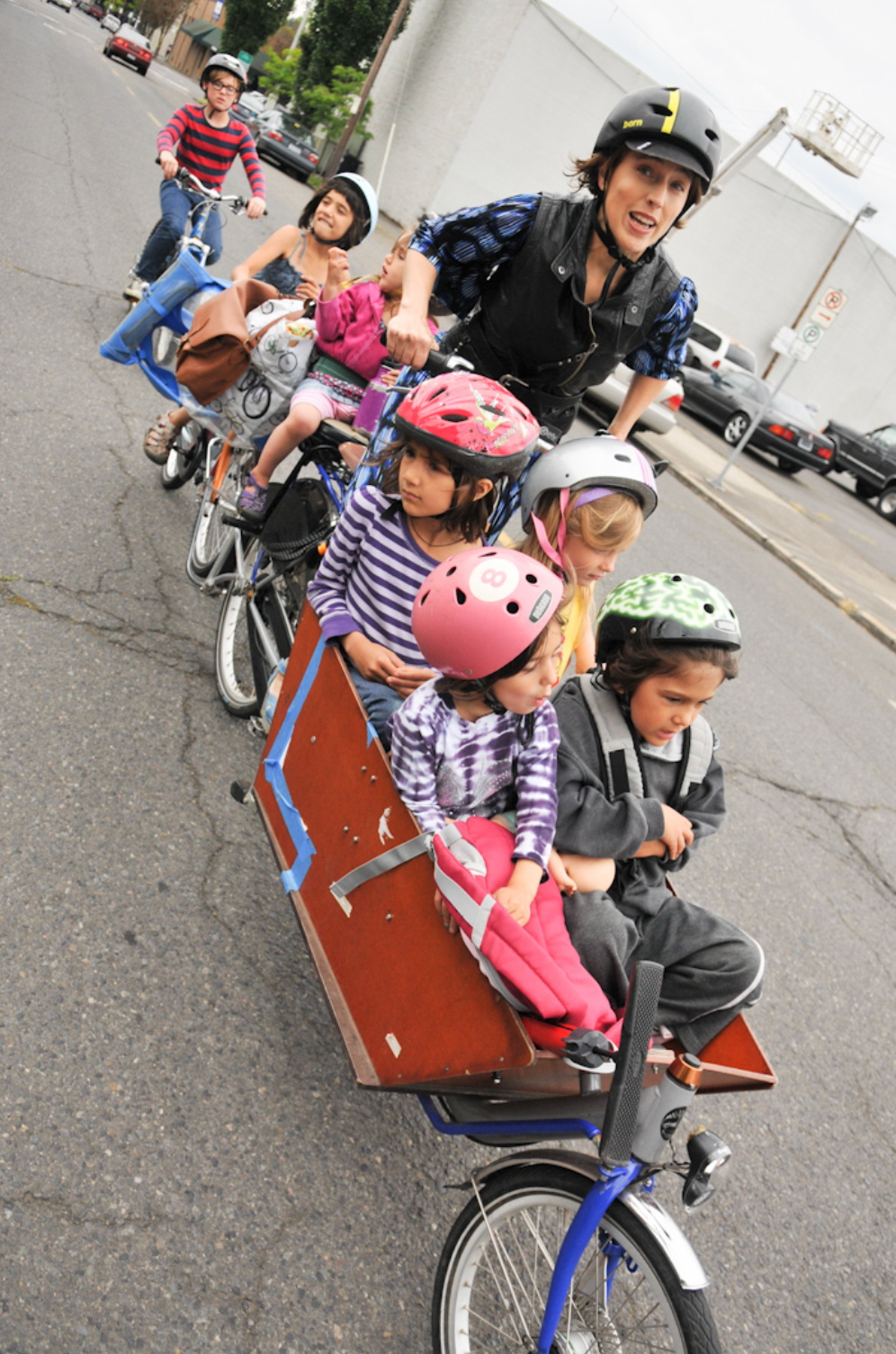
Observation of this system reveals a clear daily rhythm: In the morning around 8:00 and again in the afternoon between 3:00 and 4:00, there is a large exchange of children between parents and pedagogues. Bike wagons arrive, and children are dropped off and picked up. There is a constant movement back and forth.
This behavior, called “child exchange,” happens in many cultures, but the Danish version is quite unique because it happens every single day. It is not seasonal—it is a daily exchange between parents and educators. And it is a key to developing a core value of the Danish education system, a value Anderson calls “civil sociality.” It is part of what children learn when they are placed together in groups of 20 or more in institutional settings. This form of sociality differs from what happens at home because it occurs among a wider group of people in structured environments that introduce Danish children to society—"being among others”—at a very early age.
Themes in Social Learning
Over the years, Anderson has identified eight themes related to “civil sociality,” that characterize pedagogy in Danish schools. They are as follows, with the Danish term for the concept on the left and an explanation in English on the right:
1. Faste klasser Stable, fixed groups
2. at være social Being social
3. at være sig selv Being oneself
4. at balance Balancing self and group
5. Lighed Equality/sameness
6. at deltage/ at bidrage Participating/contributing
7. Fællesskab Togetherness
8. at stikke fingeren i jorden Sticking a finger in the ground
First, there is the question of social organization, how children are structured into groups and managed within these educational institutions. The emphasis here is “faste klasser” (stabile, fixed classes), whereby individuals are known and understood by a group of peers and a teacher. Second, children are expected to learn how “at være social” (to be social)—but not so social that they lose their individuality. Third, they must learn “at være sig selv” (to be themselves), even though that does not come naturally due to the demands of such a tight-knit group context. You might say that this is an existential ideal—how to “be” yourself—which is often a matter of performance, and which takes continual nurturing. Fourth, related to learning to be oneself, students must learn how to balance the self and the collective. Simultaneously, the fifth theme is “lighed” (equality), which calls for students to understand, mitigate, and navigate differences, which relates to the sixth theme—lesson about how individuals must learn how “at deltage / bidrage” (to take part or participate and contribute to the group).
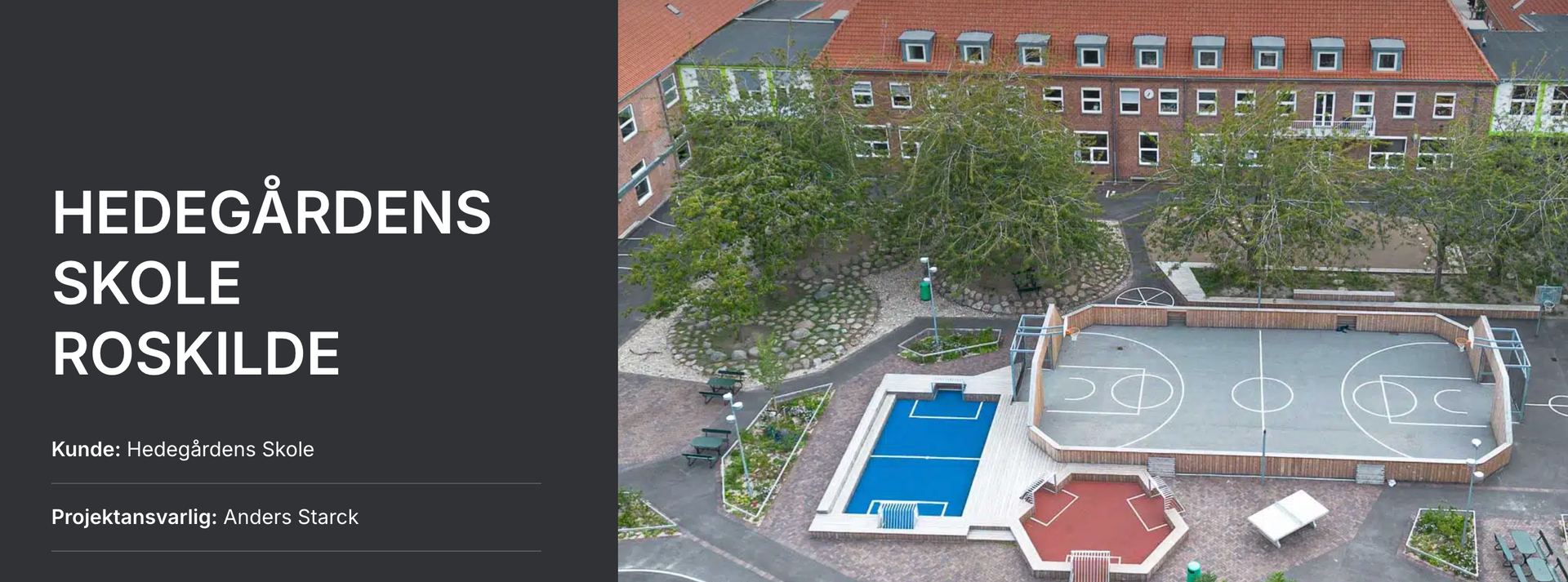
The last two themes are particularly interesting to me because of what I have seen in my son’s experiences at school at Hedegård Skole Denmark. The seventh theme of “fællesskab” (togetherness) is particularly noteworthy because it is also a deeply important cultural value. Danish folkeskole students spend a lot of time as a group, and their parents are expected to, too. Students and parents socialize outside of school. Students go on trips as a class, and their parents are expected to gather, even travel together, too. Email messages from the principal at my son’s school typically emphasize gatherings, especially upcoming afterhour meals, and at his soccer club, monthly fællesspisning (fellowship eating) constitute a crucial aspect of the team formation. And it is the final theme that Anderson lists that is likely of interest to readers of Church and Life. It is this: “If you cannot immediately figure out how things work socially, you should ‘stick your finger in the ground’—that is, take time to observe, sense, and let understanding emerge. This is a Grundtvigian concept. Grundtvig in fact wrote these words nearly verbatim in a letter to his wife when traveling (see the Postscript in the April 2026 issue). Anderson sees it manifested in how teachers and students navigate uncertain intellectual and cultural, and we see it as reflecting a broader Danish approach to learning social life.
Organizing Children and Regulating Social Life
How are these themes pursued and, hopefully, realized?
One way is organization. When children in any culture enter school, their social world becomes more structured. In Denmark, this process might be understood as anchoring their school sociability. A key guiding principle—written into Danish law—is that all children should feel that they are part of something larger than themselves. This principle is achieved by organizing children into permanent classes, where they stay together for nine or ten years. Although teachers change over time—moving from early schooling (years 0-3) to middle (4-6) and later stages (7-9)—the group of children remains the same. Through this structure, children become part of a stable collective. Teachers refer to these classes as “school families.” Within these families, children have two sets of adults, their teachers and their parents. Ideally, these adults work together, sharing responsibility for the children. Over time, ideally, everyone gets to know each other very well, and the class is intended to feel like a home within the school.
Teachers place strong emphasis on knowing their students. Teaching is not only about academic subjects; it is also about understanding the children and their families. Many teachers express the belief that in order to learn, children need to feel socially safe. Children themselves echo this idea. They say it is good to be with people you know, and that being alone—having no one to stand beside—is one of the worst experiences. This highlights how central belonging is in the Danish school system.
Once children are organized into classes, their social lives are actively regulated to allow for “fællesskab.” Today, this includes practices such as compulsory playdates, where children are encouraged—or required—to interact with different classmates. The idea is that every child should visit every other child’s home, preventing the formation of small, exclusive groups. Birthday parties are often organized to include the entire class, or all boys or all girls, rather than selected individuals. Trips, parties, and activities are typically arranged at the class level, sometimes including a parallel class. Parents are also involved, organizing social events together, which extends the children’s social network beyond school. In addition, classroom rules are created collaboratively by teachers, students, and parents. These rules may address everything from food and celebrations to technology use and behavior. In this way, the social life of the class is carefully structured and collectively managed.
Class Identity (and Difference), Social Well-Being, and Learning
Interestingly, while the system emphasizes equality and inclusion, it also fosters perception of differences between classes. Children quickly begin to compare their class with others, developing group identities. One class might see itself as “better,” tougher, or more skilled than another, even though the differences may be minimal. Teachers also describe classes in different ways—some as “impossible,” others as well-functioning. A particularly valued class is one in which no child stands out too much and where the group works harmoniously together. (This is a noteworthy point I will return to later.) Social well-being and harmony are regarded as essential for learning. If children feel safe, connected, and comfortable in their class, they are more likely to learn. (This perspective is typically unfamiliar to Americans and, it seems, to many non-Danes, but over time its importance seems reasonable.) The goal is not to divide children by ability, but to keep them together and support their development collectively. The classroom should be a “good place to be,” and if it is, then it becomes a “good place to learn.”
The Ideal Classroom— Authority, Equality, and Subtle Hierarchies
Therefore, the ideal Danish classroom is one in which all children function well together. It is harmonious, inclusive, and socially cohesive. No child stands out too much, and there are no strong divisions or cliques. Children interact across differences, make decisions together, and learn to tolerate one another’s perspectives. Ideally. Teachers work actively to help children resolve conflicts themselves, encouraging them to manage disputes rather than relying on adult intervention. If one student hits another, the teacher might ask the victim what she might have done to cause the fight. When a student leaves her lunch at home and is asked why, the student might respond that her mother forgot to put it into her bag. The teacher’s response would typically be to say, “No, you forgot your lunch; it’s your responsibility, not your mother’s.” The aim is to create a space where children take responsibility in a safe environment, a place where they can express themselves while still maintaining group harmony.
One of the aspects that can be confusing—especially for outsiders—is the nature of authority in Danish classrooms. Teachers are often addressed by their first names—it’s never Mr. Jensen; instead, it’s Hans. At first glance, authority appears minimal, but Anderson has observed that mutual respect is earned, not expected, which creates conditions for learning. It might also seem odd to outsiders that students move around the classroom and the school building of their own free will; sometimes, it takes them a while to settle and attend to the teacher when it is time to gather. This does not mean there are no hierarchies. Instead, the rules are implicit and subtle. Children must learn to recognize who has influence in different situations and how to behave accordingly. This understanding requires high levels of social sensitivity. Children learn to pay attention to what matters, who counts, and how to position themselves in different contexts. They become highly skilled observers of social dynamics—almost like anthropologists themselves.
Responses
The Danish school system places a strong emphasis on social learning. Children are not only learning academic content; they are also learning how to be part of a group, how to balance individuality with belonging, and how to navigate complex social environments. These skills are not always easy to learn, but they are fundamental to fruitful participation in any society, and it seems to be working especially well here—any clear-eyed, engaged visitor to Denmark can see that Danish people are, in general, very well educated and cooperative. Denmark is a prosperous nation.
During the presentation, my initial, somewhat cynical reaction was to relate Danish pedagogy to "Janteløven" (The Law of Jante), which comes from Aksel Sandemose’s 1933 novel En flygtning krydser sit spor (A Fugitive Covers His Tracks). In the book, citizens of the fictional town of Jante follow a set of unwritten social rules that might be summarized as follows: "Do not think you are better, smarter, or more important than others.” Related rules include not to stand out, not to boast, etc. When I first came to Denmark 23 years ago, I was told that evidence of Janteløven could be seen everywhere. Just look, I was told, at the Carlsberg Beer sign in Copenhagen's town hall square, which says, "Carlsberg, probably the best beer in town."
But the question-and-answer session that followed Anderson’s talk increased my sense that Danish pedagogy does something vital for a democracy by prioritization of "civil sociality." Of course, all social spaces have their own unique tensions. But Danish schools, like the one my son attends, and the Danish workplaces I've seen, like Copenhagen University where I’ve been doing research -- these places discourage hierarchies, yet (and possibly as a result) they are productive, pleasant places to learn and work. (My son has enjoyed his semester.) Also during post-presentation discussion, one audience member voiced concern over a leveling of the students that potentially hampers the education high achieving students in order to accommodate lower-achieving ones. This might be the case, sometimes, but the main takeaway for me, as a parent, student and scholar who has experienced both American and Danish models, is that values and pedagogy are hardly separable. (The International House should be congratulated on open acknowledgement of this fact.)
We teach and learn what we value, and if we value civil sociality (social harmony and general collective well-being) more than individual progress and productivity, we might choose the Danish model.
Experiences with the Danish and International school systems
By Nanja Holland Hansen, Ph.D., licensed psychologist
A student in two different systems
In every fiber of my being, I know exactly how to navigate the social world that we have been taught and shaped by in the Danish folkeskole. As a child going through this system and not knowing anything else, it felt very safe and very stable. I walked or biked the same way to school every day. I went to the same classroom with the same twenty children every day. My teachers came to me—notice I say my teachers came to us; we didn’t go to them. The classroom was a safe space. It was our home. It was where everything that transpired between us as children took place, either there or in the schoolyard.
My classmates and I knew exactly what to do. We knew what games to play during breaks—it was usually soccer—and we knew exactly how to pick teams. Sometimes it was just the boys who played soccer, and other times girls would play games like throwing a tennis ball against a wall and jumping over it. We spent a lot of time doing these things, but the key point is that we just knew how to get along, and we knew exactly where we fit in.
We also knew things that were never spoken about. We knew which children couldn’t read very well. We knew which children had to leave class to get extra help. We knew which children weren’t functioning well socially or had difficulties at home. We knew whose parents were divorced, whose parents were struggling, or even drinking—but we didn’t talk about it. It was just part of the shared understanding of the group.
We also had a parallel class of students who stayed together throughout their education--and we did not like them. It wasn’t until around eighth or ninth grade that we began to tolerate or even like them, and even our acceptance of each other depended on shared interests like soccer. But school had a very clear structure: School felt safe, predictable, and stable. The teachers were caring and attentive, especially in terms of social and emotional well-being. What I don’t remember very clearly is the educational aspect being important. I don’t remember teachers being concerned that I didn’t start sentences with a capital letter in fifth grade. I don’t remember teachers being overly worried that I didn’t fully understand math. It felt more like, “you’ll get it eventually.” For me, school was about being with my friends and being part of the group—it wasn’t primarily about learning academic content.
As in any system, the rules at my school were often not spoken; instead, they were very strongly felt, especially the moments when we stepped outside them. My classmates and I learned exactly how not to stand out too much. We probably couldn’t explain how we know that rule, but we did. I can’t tell you exactly what “too much” is, but I can tell you the moment it happens. There is an immediate sense of discomfort—and even fear—when I crossed that invisible line. I knew when I was going against what I was supposed to say or do. I knew when I was sharing my real opinion instead of the opinion I thought I should share.
These experiences shaped the way I engage socially in every aspect of my life—from being a child in the Danish folkskole, to being a young adult, to how I interact in workplaces today. This way of being social together is deeply learned, and in my opinion, it is the most important thing we take from the Danish school system. Education, in terms of academic knowledge, often feels secondary.
I spent all nine years at the same school. At one point, my parents moved us to a different city, and I had the option to switch schools. However, I was absolutely determined not to do that. The idea of entering a new class that had already been formed was extremely frightening. Where I was, I understood exactly how belonging worked. I knew who was part of the group and who was not, who was new to the school and who had always been there. I knew I did not want to be the new kid—especially when I was 13 or 14. I wanted to stay where I knew everybody, where I knew the rules, and where I felt secure. When I had a chance to changed schools, I refused, and I stayed for all nine years with essentially the same group of children.
Then, I experienced a new model of education. After my first year of high school in Denmark, I went to the United States for a year. That was probably the first time I realized that schooling could be done very differently. Suddenly, things were formal. I had to call my teachers “Mr.” or “Mrs.” instead of using their first names. That felt strange and distancing, as if something was missing in the relationship between student and teacher. At the same time, academics became very important. There were frequent tests and evaluations, and I was expected to demonstrate what I had learned.
This was very new to me. In Denmark, we normally had exams at the end of the year. In the U.S., my learning was constantly assessed. Teachers expected me to learn, to remember, and to perform. For the first time, I experienced that teachers truly expected me to acquire knowledge. One teacher in particular made an impression on me. My English teacher in the U.S. would not let me just sit and draw when I finished early. Instead, she gave me more books and required me to write reports. That was very different from my experience in Denmark, where there was less urgency and where I was conditioned to believe that learning would come eventually.
At the same time, I noticed a few negative implications of the American stress on learning. Many students were very good at memorizing information for tests, but they sometimes struggled to form independent thoughts, express opinions, and engage in discussions. That made me realize that the Danish system had taught me something valuable—the ability to think critically and express my own perspective. This was most obvious in group discussions.
When I returned to Denmark, I tried to bring some of that academic motivation with me. However, I quickly ran into the limits of the social system. For example, I once pointed out a mistake my English teacher had written on the board. My intention was to correct it so we could all learn properly, but I had stepped outside the social norm. As a result, my grades dropped dramatically. When I went to the vice principal to discuss the issue, I was told, “Maybe you should just not say anything. Maybe you should just let it slide.” I remember thinking this was unfair, but I also understood exactly what he meant: don’t rock the boat, don’t stand out, don’t challenge authority. Eventually, my parents intervened, and my grades improved again, but the experience showed me how difficult it can be in the Danish system to step outside established social norms.
A parent with two different children
As a parent, I experienced the Danish folkeskole from a new perspective. My daughter, my firstborn, started in class 0, and by third grade she was so bored and frustrated that she came to us—my husband and me—and said, “I don’t want to go to this school anymore. Please, please find another one.” She didn’t really care about the social structure of the Danish public school. What she cared about was learning. She was curious and wanted more. She didn’t care whether she fit into the social norms or not; she cared that when she had finished her work, the teachers would say, “Okay, now you can sit and draw.” And she would say, “I don’t want to draw. I want to learn more. Can I do more math? Can I do more English?” I spoke to the teachers and tried to support her. I even brought in extra materials so they wouldn’t have to spend time preparing additional work. The teachers were kind and well-meaning, but I think this was more about the structure of the system than about their intentions. We were trying to navigate a system that wasn’t built for a child like her—one who didn’t want the social aspect; instead, one who wanted to learn and be challenged.
When she started fourth grade, she left that school and went to a school for gifted children. The change was immediate. From one day to the next, we had a happy child. She was given exactly what she needed—more, faster, and more challenging. At her old school, she used to ask, “Why are the teachers saying the exact same thing four times? I got it the first time.” Back then, we had to explain to her that not everyone learns at the same pace. At her new school, she didn’t ask questions like that anymore. In seventh grade, she decided that she wanted to continue all her schooling in English. She said she didn’t necessarily want to live in Denmark, so she chose to shift to the international school. That decision reflected who she is—independent, curious, and driven to learn.
My son is very different. He also started in class 0, but unlike his sister, he had already spent three years in daycare with many of the same children. So, when he entered school, he already knew most of his classmates. From a parent’s perspective, this felt reassuring—we knew the children, we knew the parents, and we even had preferences about who we didn’t want him to be in class with. When the class lists came out, we were honestly relieved about how it turned out. That’s how much this idea of fitting in matters.
For him, school initially worked well. He liked playing soccer, and he was flexible—if he learned something, great; if not, that was also okay. He liked math and physical education, but he didn’t like Danish. The teachers knew all of this about him. They understood his personality and how to approach him. They knew that if they pushed him too hard, they might lose him, so they worked carefully to encourage him step by step. This is something I really see as a strength of the Danish system: Teachers know the children very well and know how to navigate their personalities and needs.
But over time, things changed. My son became one of those children who took care of everyone else socially. If someone was upset, he would go and comfort them. If there was a conflict, he would step in and try to solve it. He was constantly managing the social dynamics of the class. And it exhausted him. We began to see it physically. Every morning he would say, “I have a sore throat.” If he stayed home, the sore throat would disappear. But if he went to school, he would come home completely drained. He had spent all his energy navigating the social environment, leaving nothing for learning.
At one point, we talked to him about whether he wanted to move to the same international school as his sister, and he said yes. Again, the change was immediate. From one day to the next, he became happy again. He had energy, he could concentrate, and he began to enjoy learning. In this new environment, I could also clearly see what he was learning and how he was progressing. The teachers provided structured feedback—what he could do, what he needed to improve, whether it was writing paragraphs or using capital letters correctly. It became much more visible.
Reflections on children and learning
Looking at both my children, it’s very clear to me how different they are—and how differently they responded to the same system. My daughter didn’t thrive because she wanted academic challenge that the system couldn’t give her. My son, on the other hand, initially thrived socially, but eventually became overwhelmed by the demands of constantly managing those social relationships. Both changed dramatically when placed in a different environment. And for me, these changes highlight something essential: it’s not about one system being better than another, but about understanding what kind of child you have. Some children need strong social structures; others need intellectual challenge. And sometimes, those needs change over time.
The Danish system excels at creating social cohesion, belonging, and strong interpersonal awareness. The American (or international) system places a stronger emphasis on academic achievement and intellectual development. Neither system is perfect, and the key question becomes: What works best for each individual child? Children are different, and their needs change over time. One child may thrive in a socially focused environment, while another needs more academic challenge. For me, the conclusion is not about choosing one system over the other, but about staying curious—about our children, about ourselves, and about the systems we inhabit—and asking: where can people truly thrive?
DATELINE DENMARK
By Edward Broadbridge
Trust in Denmark
On 7 November 2024, "Our World in Data" published an overview of "trust" in an international context, based on the annual World Values Survey. Denmark came top of the list with 74% saying "most people can be trusted." In the 1970s this figure was only 48%. Denmark was followed by Norway, Finland, China, and Sweden, while the USA ranked 9th, with 37% agreeing with the statement. The highest trust institution is Statistics Denmark with 86% accepting its findings. Alongside them are the courts and the police, which have a similar trust level. Further down the list come the EU (66%), the News Media (58%), and Parliament (57%). Denmark’s welfare state was founded very much on mutual trust, with all its 6 million citizens having the right to certain fundamental benefits and services. To achieve this the average Dane pays 35.7% in income tax as compared with 14.5% in the USA.
Speaking to The Guardian newspaper, the political scientist Gert Tinggaard Svendsen argues that trust accounts for 25% of Denmark’s otherwise inexplicable wealth. By his reckoning, a quarter of that wealth comes from physical capital (means of production and infrastructure), half comes from human capital (the population’s level of education and innovation), and the unexplained final quarter is trust. He says, “They don’t sue one another, they don’t waste money on burglar alarms, businesses often make binding verbal agreements without sweating the contract. People who hold power in Danish institutions – the government, police, judiciary, health services – are trusted to be acting in society’s best interests, and there is very little corruption.”
Trusting Danes can unwittingly fall foul of the law in other countries, including the USA. A notable and memorable case happened in New York in 1997, when Anette Sørensen left her baby in a stroller outside a restaurant while she dined inside, keeping an eye on her child. A restaurant patron reported her to the police, who arrested her on a charge of child endangerment and strip-searched her, while child welfare authorities briefly took charge of the girl. The charges were later dropped but Sørensen filed a $20m false-arrest lawsuit against the city, and in 1999, a jury awarded her $66,000 in compensation.
Several studies have examined the link between trust and immigration, which some have argued is a major negative. The studies come to the conclusion that despite the new world that immigrants enter, often from repressive regimes, their newfound freedom to diverge from Danish law and custom in their new environment is only "relatively minor." Most immigrants welcome their new opportunities and by and large integrate reasonably well into Danish society. Take, for example Copenhagen FC, where 76% of the entire squad are foreigners! They may be resident for a few years only, but conversely they are also high-profile figures – from the Brazilian Gabriel Pereira to the Moroccan-born Norwegian (!) Mohamed Eyounoussi. These are role models not just for other immigrants but to a certain extent for all the club’s fans.
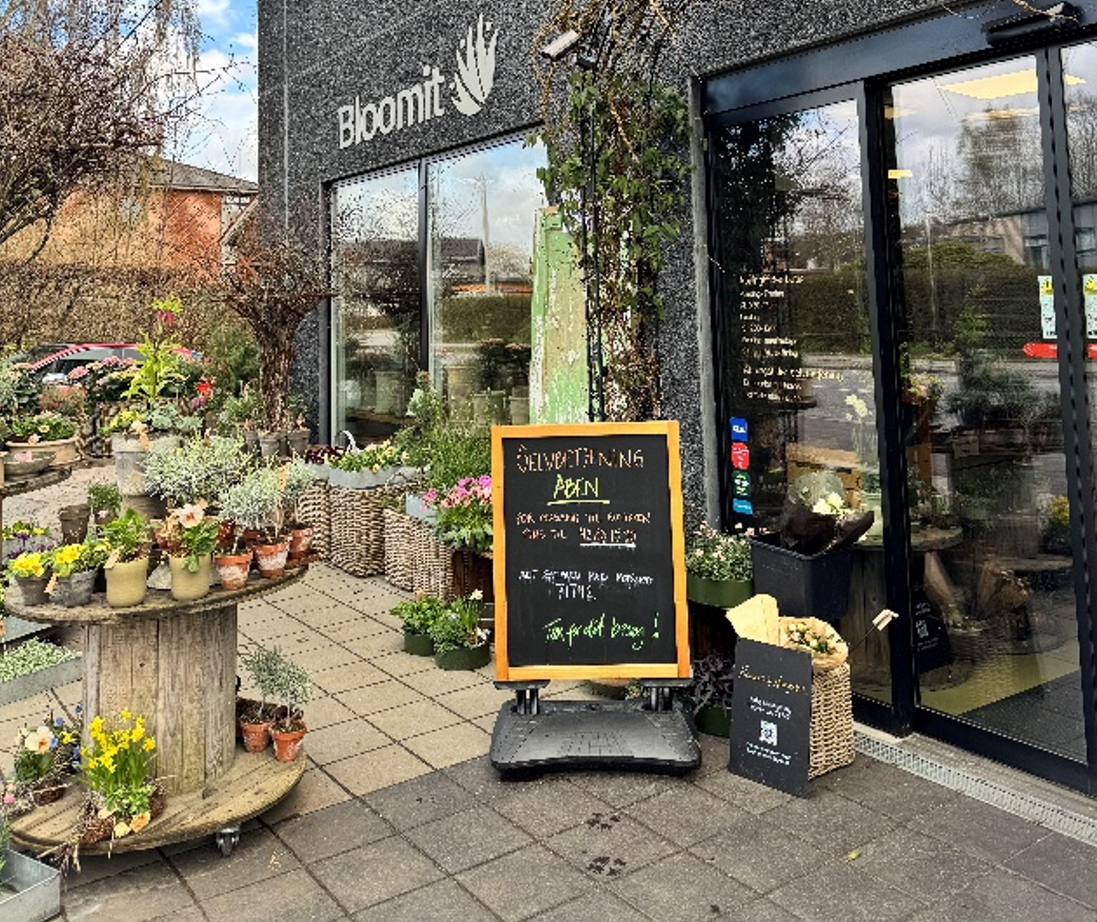
The above photo of my local flower shop in Randers, Denmark, where I live demonstrates this high level of trust. When the shop closes on Saturdays, the owners leave various flower arrangements outside with prices attached. You can purchase these on the spot, thanks to the Danish system of Mobile Pay, whereby you can pay for anything via your phone. In many other countries the flowers would disappear without payment, especially in the dark of the night. But not so in Denmark, where people honour the trust, pay the price, and buy the flowers.
A Contested Marriage
By Erik S. Hansen
A marriage opposed is not necessarily a marriage failed. Neither is it any guarantee of success. Conventions may intervene to shape the outcome, and so may happenstance, or headstrong conviction. One defiant young woman in love with an older man of another stature does not immediately alter the circumstances of either family’s station in life. But the lovers are forever changed. While they may never make themselves over into individuals of original mint they might wish to be, however much they choose to look beyond their origins of descent, they escape simultaneously into both past and future to test and bend the limits placed upon them. Only then do they reignite the spark of creation and emerge in the afterglow illuminating their humanity.
When the Jonsens initially objected to releasing their youngest child Mette’s hand in matrimony to my great grandfather, the moorland crofter Anders Toft, they did so not in any vindictive way. They were not mean-spirited people. Nor small of mind. Time would prove them to be quite the opposite. Two generations later, when Mette’s children’s children returned to visit the Jonsen family in Denmark, they were found to be open and accepting of their curious American cousins. Any lingering objections either had been forgotten by them or suspended in neglect. If nothing else, the family resemblance was immediately recognizable. “Why, you look just like us,” a great aunt said to my father. The power of individual will merged with the march of time to reshape all manner of daily lives after Mette got her Anders, or vice versa.
The Jonsen family’s only indiscretion, if they could be ascribed any at all, stemmed from a purely personal sense of self-preservation. A compound base of opinion about themselves had been laid down over generations, like annual aerobic layers of soil inching upward out of the peat bogs of primaeval Europe. Theirs was the long residue of post-glacial rise along the Neolithic ladder rungs of evolution. From hunter to gatherer, farmer to gardener, from land grabber to landgrave, their advance was matched only by how little change actually had occurred.
Some years after the already aging couple of Anders and Mette sold their Danish farm, such as it was, and along with the full family complement of seven remaining children converted all their earthly possessions into ready cash and emigrated to America, the grave of a young woman was discovered in the nearby medieval town of Egtved, just across the river from where Mette Jonsen had grown up. A hard-headed Jutland neighbor thumped a prybar against a hollow tree trunk coffin that had been preserved under an old stone setting mound for three thousand years. He was clearing rocks away on his high ground pastureland, intent on adding tillable acreage to his fields, as his kind had done for generations. This discovery of the girl’s grave occurred in 1921, just after the return of the southern peninsula of Jutland to Denmark following the German defeat in WWI. Full consideration for antiquities was only beginning to be imposed by more liberal governments. The law of conservancy had not yet been mandated—and prior to that, in practice, only by modest enforcement of the concept.
What the ages hid, the need and greed for land revealed.
South central Jutland still exists as a kind of kettle-forge for what would become the country of Denmark. Heathland hills and outwash plains mark the end moraine advance of glaciers after the last ice age. To this day fields and forests frequently offer up artifacts from the past. A walk along a plowed furrow may reveal anything from fossilized dog whelk shells, to stone spear points, to bronze axe heads. A record of the march of time. And everywhere are flint shards flaked by a napper’s hand. This was the Silicon Valley of its time. Advances in stone tool technology were followed soon after by the application of fire to base metals. First copper and tin were combined to make bronze. Then bog ore smelted into iron. Together, each age made for leaps ahead in lifestyle and material culture.
No more evident was this than with the remains in the grave found in 1921 in the Egtved farmer’s field. The young woman buried there lay in ceremonial repose, dating from well before the time of Christ. She was clad, resplendent, in sun-worshiping jewelry and an ever so skimpy costume skirt, braided of string and with a big bronze belt buckle. Immediately, she was claimed as the embodiment of Nordic beauty. Her skeletal body was completely gone, but with locks of hair intact along with fragments of skin and teeth and fingernail, enough remained of her to know this was no ordinary human being.
Here were remnants of the flesh of the first inhabitants—a legendary Mother Denmark, it could be said.
The Egtved Girl, she was named. And so she came to be called, though younger than first thought. In truth, she proved to be barely an adult, a girl of mid-to-late teenage years, though still the epitome of Scandinavian comeliness and pulchritude. But the Egtved Girl’s past concealed a more complicated history and geography linked to her.
Her initial discovery story was swathed as much in cobwebs of faulty scientific theory as it was in the prejudices of the time. Well to remember that in 1921 phrenology and racial stereotyping were not limited to followers of the self-proclaimer of empires about to emerge across the newly drawn borderline to the south with Germany. That national boundary had just been moved again, when the lower peninsula of Jutland was returned to Denmark after WWI. Danes now had a sizeable part of Denmark back within its perimeter again. Their own brand of national romantics, if not fanatics, was eager to celebrate the reemergent prowess of the Nordic races, now that the country was whole after a half century of outside domination.
It was a time when the Modern Age had come down and come down hard on Europe. The war to end all wars had ended in an uneasy peace. Big city swing—the Weimar Republic and Roaring Twenties—was just getting started. Ironically, for Denmark, a last flowering of bucolic, rural culture bound to the natural cycle of landed peasant farmers and seasonal landscapes kept the country at least a generation behind the rest of Europe. Briefly, it was a resurgent, happy time for Denmark. A second German occupation, this by the Nazis, was still two decades away.
The Egtved Girl’s remains immediately were put on public display in the national museum in Copenhagen. She became symbol for a renewed nation, particularly as promoted by prominent author Johannes V. Jensen, Denmark’s last of three Nobel Prize winners for literature. Jensen viewed the girl as symbolic of simple and enduring Danish values. He countered the initial interpretation of the museum’s director that the Egtved Girl, with her short skirt and no underwear, might be a sun-dancing cult goddess, a sex symbol. The director’s view was implausible, Jensen claimed. Instead of viewing her in this southern, sun worshipping light, Jensen wrote that anyone with even passing knowledge of Nordic values would recognize immediately the mindset of down-to-earth Danish women. The latter would never make an art form of exposing their bodies in public, the laureate Jensen wrote.
So it was the girl from Egtved became a 3000-year-old instant celebrity, if also eventual model for controversy over the disposition of human remains . . . not to mention present day contention as to the origins of the Danish people.
Had we remembered who begat whom—as did, no doubt, my great grandfather Anders Toft, devout pietist that he had been in his early years—we would have known that everyone is on a pilgrim’s passage on this earth. Immigrants all, we are, begat from a common lineage, no matter what Biblical bias later claimed for ancestral dominion at the top of the evolutionary food chain. Had Anders still been in Denmark, or even alive, when the Egtved Girl was found, mere miles across the river from where he courted his Mette on her home farm, there would have been little doubt in his mind that the Bronze Age burial girl was a distant relative of them both. Nor would he have been surprised how the former immediately became a prototype of desirable Scandinavian femininity. He knew what beauty lay in the eye of the beholder, as he had found in his Mette.
*
The Egtved Girl’s lineage now has been confirmed. For some she still stirs controversy as to the true antecedents of the Danish nation. DNA doesn’t much lie, however. Her nucleic acids proved to exist in sufficient quantity to enable micro-slice biology to solve the riddle. The Egtved Girl’s birthright has been identified through isotope dating and dendrochronology matches, all confirming that this Bronze Age beauty turns out to be a teenage single mother and nomadic wanderer from much farther south in Europe.
She’s an immigrant to Denmark, two thousand years before there was a Denmark.
Still, it’s hard not to fall in love again with this young woman, just as Anders had with Mette. Even if, irony of ironies, Mette long since had become an immigrant herself, having bundled the family off to follow hard-headed husband Anders to America many years before. By the time the grave of the sun girl was found across the river from her home farm, she and Anders both were long dead and gone.
The Egtved Girl’s story proved to be a sadder one than Mette’s own. In one sense, though, it mimicked her family’s fortune in a particular way: The Bronze Age girl had died an early death, only sixteen, eighteen maybe, similar to one of Mette’s own sisters, who succumbed in childbirth and left behind a baby that lived only three years. Then a generation later, Mette lost her own five-year old son early on, and then later a teenage daughter, Karen, who died, tubercular, at eighteen. This daughter Karen’s death may have been one of the pretexts for why the Toft family pulled up stakes and left Denmark altogether, bound for America.
The Egtved Girl also once had left Denmark. Maybe more than once. But she had come back. For she was a wayfarer with a purpose far beyond the ordinary, as evidence from her grave would reveal.
For one thing, buried next to her body were unusual artifacts intended for a metaphysical journey to the world beyond. A birchbark bucket placed beside her once had been filled with mead, for libation. A bronze awl lay ready for handiwork, or protection. Even a comb was included in her grave goods, to smooth her fulgent locks of hair. But that was not all her tomb contained. Recent application of modern scientific techniques of dating reveals elements of even greater mystery to her story. Not the least were seed spores and wool samples on her person that trace her place of origin. She wore a textile and pollen record like a GPS fingerprint, both products of fauna and flora far to the south. She was not Danish at all, as first claimed by Nobel laureate Jensen. Though in truth, how could she be? There was no Denmark at the time. More likely, the Jutland peninsula and surrounding islands, still rebounding from the lifting weight of retreating glaciers, were but a vaguely drawn ultima Thule nomados, or distant pasture, as the region was labeled on early mariner’s maps.
The Egtved Girl herself proved to be a formidable navigator of this terrain. And one of recent and major mobility. Radio isotope evidence records show she had been to the north before. And more than once.
This roaming itinerant girl had arrived overland, recently wandered in from somewhere down around the Black Forest of south-central Europe. Perhaps she was searching for something, or someone, the nature of which possibly is revealed by one additional burial item. A small pouch placed beside her tells the story of an intentional traveler. Next to her head lay a cinched purse filled with the ashes and bone bits of another human being.
A child was buried with her, a baby’s cremated remains.
What to make of this double interment? Had the two been human sacrifices? A baby brother or sister buried with her? Humans were known to be martyred in the Bronze Age. Or was she a solar priestess presiding over a voyage to eternity? A kind of divine babysitter, a nanny, slain to accompany a favored child into the afterworld?
Numerous ceremonial sacrifices have been found elsewhere in Denmark. These slayed remains often appear to be attempts to appease the gods. Or attempts, dually, to pave way to eternity. The base human aspiration of living forever did not arise just yesterday.
But this grave is different. This is not a Bronze Age sacrifice. Those victims of offer usually ended up tossed into a peat bog with throat cut or a noose still around the neck.
Not so the Egtved Girl. Her mortal destiny in decaying half-lives is now delivered into our hands. Wherever and whatever her intended destination, buried as she was with both beauty aids and baby bone dust beside her, bound for some higher plateau in the afterlife, her body ends up in a place nearer the here-and-now. Temporarily, she was given residence on display in the National Museum in Copenhagen. And there she lies in repose to this day, her remains and the child with her on display in a glass box visible to any modern-day visitor. But that is not her only final resting place.
Where else does she lie then? And why, we can ask, had she come back to Denmark at all, before there was a Denmark, if not but to seek out the father of the child at her side? And why, so buried, would she be honored with ceremonial set pieces under stone boulders piled atop her coffin to protect the grave from plunder? Only the favored few got such a ritual stone mound—broken apart by the fumbling Jutland farmer looking to put a plow to another half-acre of land. Why all of this, if the Egtved Girl first had not been reunited with her paramour chieftain before she died?
A simple question, and simple answer, to so complex a destiny.
One other clue lies with her. Even in her final rest there is a tender truth to read. A stem of a yarrow flower blossom was placed in the coffin beside her on her burial bed. How could this not be anything other than a final farewell from the father of her dead child?
Yes. Why not?
The Egtved girl, so named, once exhumed, now can be claimed by us all. All the more reason to gather round the dimly lit museum display case preserving her remains. Seeing her oak coffin under soft light—the sun dress and bronze buckle remaining, the pouch with baby bones—we ponder our common ancestry. We place a hand on the transparent case containing her remains, a separation of millennia by mere millimeters of glass. Her clothes and her hair braids and the accoutrement of worship are arranged on cowhide and woven blankets, now under close climate control, relayed to us from long ago and places far away.
Yet she presents a familiar picture. Little different is she than when my own father reached out his hand as a five-year old to touch that of his grandmother, Mette Jonsen Toft, dead and lying in an open casket placed under an apple tree on a hot August day outside the house on the home farm on the southwestern Minnesota prairie. With a child’s curiosity, he remembered the smell of decay in the humid air. It was an introductory memory of death he never forgot. And he recalls reaching over the edge of the wooden coffin to touch her hand. He was just tall enough to inspect her fingernails, grown long like the Egtved Girl’s, ready to be clipped. And then he let her hand go.
He told this story with the same reverence, maybe even the same day, when he related his first visit to Denmark. He had sailed across the Atlantic in the Thirties with a group of Danish-Americans traveling on a visit to the homeland. For him it was the first time seeing the land he had heard so much about, and whose language he spoke and wrote better than he did his native American English. He and a female cousin of his were along in the travel group. Together they visited the Jonsen farmstead and family in Ravning, located just across a shallow valley from Egtved and meandering brook at the mouth of Vejle Fjord. It was there my father met his grandmother Mette’s family. Her brother’s second wife, a woman also named Karen, was still alive, an old woman. In truth, Karen Jonsen would live another twenty years, till she was exactly a century old, dying on her 100th birthday. On the day of his visit, great aunt Karen, still very much alive, looked him up and down and told him: “Why, you look just like one of us.”
And so he did. Handsome enough when young, all those boys on the maternal side of the family had dark, deep-set eyes and swept-back, wavy hair, with that high forehead and brow of the maternal side of the family. This was merged in my father’s appearance, through the marriage of Mette with the movie star-dimpled chin of Anders, the other side of the family that had come up from Germany in more recent generations. My dad also visited that side of the family, the Toft side, who stemmed from Kartoffle Tysker, Potato Germans, brought in to teach the Danes how to raise a new crop that could grow in sandy, infertile, moorland soil of Jutland. That family claimed there was royalty in that line, on his grandfather’s side, by way of the nearby manor farm Donneruplund, as it was called from the Platt Deutsch, meaning Thunder Wood. But that stem line seemed to have backstepped for a time into penury. The manor long since had been sold at auction, whence it passed in various property transfers out of that branch of family. He met both sides of the family tree on the trip in the Thirties. He always said he liked the Jonsen side better, despite their original objection to his grandparents’ marriage.
Not that Mette Jonsen herself, when young, was any fair-haired Valkyrie, though she must have appeared so to her suitor Anders, bold as he was to court the wealthier farmer’s daughter with dark shaded hair like his own. We see her visage first preserved after mid-century with the advent of camera obscura photography. No comely blonde was she. Great-grandmother Mette, stern of mien, hair drawn back tightly in a bun, presents a formidable figure. We see her on the day they were joined together in matrimony. In their wedding photo, already then, Mette looks old. And when we see her recorded next, she’s double that age and half a world away in America, having borne Anders nine children, two of whom died young and were left behind, buried in the cemetery consecrated at the home church not far from where the Egtved Girl later was exhumed. By then, Mette is only a few years away from the grave herself, that day remembered by my father under the apple tree on the home farm out on the prairie.
Their legacy of intimacy—Mette and Anders—I allow myself to consider as a foil against these thoughts of gradient decay. Though hard it is, to be sure, to dwell for long on the conjugal life of one’s own great-grandparents, let alone the generations that followed and directly begat me. Profligate still, it must have seemed, this attraction in contravention to the Jonsen family, when the youngest daughter, still a teenager, married against their wishes. Then the newlyweds producing off-spring every other year like staggered lambing of the ewe, an outward increase of the family flock in which any singular gap in the annual record signified either a miscarriage or a stillborn child.
To think two people, so old, so long forgotten, could have held such passion for each other. Their biological attraction is traced in the names and dates inscribed in church record books that follow them through the ages. Late-night consorts, no doubt, were no different then, than now. Yet the mind balks at imagining too much detail. Daily confines of routine toil would seem to argue against behaviors of arousal and the selection of random sites of assignation. But it happened. The brain gets the bends seeing them entwined in coital acts, whether atop hayricks or on straw-stuffed mattress ticks, the temporary beds of antiquity making permanent the tendency toward self-perpetuation.
Easier it is to trace that family lineage on paper, where the generations are tracked in parish records kept by the hand of Protestant Lutheran clergy. The names are aligned by sex. Boys come first, by birth year and baptism. Then the girls, listed separately, as was the custom of recordkeeping in the Church of the Danish People, Folkekirken, as it was called. Even easier it is now, by contrast, to follow the human lineage sequenced by a swab of DNA off the tongue. Digitized results of laboratory analysis make for genetic markers that spiral back on the laddered helix defining our evolutionary biology. As the full genome of humanity is written, a picture appears clearer than any plate glass wedding image of Anders and Mette. One need not look far, nor long, to know the carbon record and genetic analogue is incontrovertible. Leap a few generations, and we all are related to the Egtved Girl.
The last time I visited the graveyard of the home church in the next town plus one over from Egtved, looking for evidence of distant relatives, I found the neatly bonsaied hedges and narrow gravel paths led only to a vanished record of their existence. One exception was a family headstone, broken off and set aside along the back wall of the cemetery. It carries the family name, all that’s left written in stone. Otherwise, the graves of the dead daughter, the baby brother, and other relatives are gone.
Human remains ultimately go to ground. It is in our organic nature to be returned to the dust and the clay from which we came. But are they really gone? And where else do they reside now, like the Egtved Girl, if not also in our hearts?
And why should any of this really matter?
Except for this:
One wonders about these things?
Where do we come from? Where do we go?
Sankt Hans Aften at the Museum of Danish America
You’re invited to attend the Museum of Danish America’s free Sankt Hans Aften celebration in Elk Horn, Iowa, on June 20 from 5:00 to 10:00 pm! Sankt Hans Aften, or Saint John’s Eve, is a Danish style midsummer festival.
- Explore our many exhibitions on view
- Browse and shop the museum’s design store
- Visit Fjord Færgemand: a lumbering troll sculpture by world-renowned recycle artist Thomas Dambo
- Eat the Danish hot dogs served at 5 p.m.
- Hear a performance of The Tivoli Troubadours at 7 p.m.
- Stay to enjoy lawn games, s’mores, Danish snobrød, and a bonfire at sunset!
- Pack your own lawn games, seating, beverages, etc., and be sure to bring your friends!
- Feel welcome to attend!
Sankt Hans Aften is sponsored in part by the Rebild Heartland Chapter and Shelby County State Bank, Harlan, IA.
History of Sankt Hans Aften (Midsummer)
Before Christianity came to Denmark, Scandinavian peoples celebrated the longest day as a supernatural struggle between light and dark, heat and cold. Since the feast day of Saint John the Baptist occurred on June 23, near the date of the annual summer solstice, the Christian Church emphasized this celebration in Scandinavia. “Hans” is the diminutive of “Johannes” or “John.”
In the late 19th century, it became common to affix a figure resembling a witch on top of a bonfire. The witch is said to be sent back to Brocken/Blocksberg in the Harz Mountains of Germany, reflecting the uneasiness Danes felt about their powerful neighbor to the south. Some Danes regard this part of the tradition with mixed emotions as it evokes memories of the horrible persecutions and “witch” burnings carried out in Denmark and other European countries in the 17th century. However, this custom is only a little part of the overall tradition. Over time, the tradition of lighting bonfires became dominant, and other rituals gradually diminished as people enjoyed the coziness of gathering around a warm fire.
Songs and music are also a part of this tradition. During the 19th century, the singing of traditional folk songs was replaced by patriotic songs. The most popular of these is the Danish patriotic song "Vi elsker vort land" (given at the opening of this issue of
Church and Life).
Danebod Folk Meeting
Come and experience the Danish folk school tradition of life-long learning at the annual Danebod Folk Meeting, where teachers and students learn from each other. At the 2026 Folk Meeting, August 19-23, in Tyler, Minnesota, professionals and participants will come together for three and a half days of mutual learning. You will hear from experts on topics like campaigning American style, literacy and Legos, unpacking a chamber music work, and translations of Louis Jensen’s “Square Stories,” and you will have the opportunity to let your voice, questions, and perspectives be heard! All events, from lectures to leisure, are designed for active participation and engagement.
In the spirit of Grundtvig’s goals for life-long learning, this year we are offering two afternoons of experiential activities for small groups. Attendees will be able to choose to:
- Join a team of Danebod pastry chefs to make almond, cherry, and apricot pastries to serve to all the Folk Meeting participants on Friday after your class.
- Hike at Camden State Park, exploring the history of the park with a park ranger or hiking with a local park enthusiast.
- Explore your inner artist in a drawing class. Learn the principles in basic drawing of the human figure; drawing from life with a human model to develop a sense of proportion and feel of movement.
- Experience the joy of folk dancing for the body and soul.
- Explore the hidden depth of your daily life by turning everyday objects, old memories, and forgotten experiences into rich, vivid poetry.
- Try your hand at basic wood carving and learn the Scandinavian figure carving style.
- Participate in the Danish art of paper-cutting, making intricate designs for Christmas and other seasons.
- Hone your skills in chess, from the basics of setting up the board and moving the pieces to playing the Larsen Opening, the Scandinavian Defense, and the Danish Gambit.
Join us in August (19-23) on the Danebod campus in Tyler, Minnesota, for three days of lively discussions and hands-on learning! Learn more at danebodfolkmeeting.org.
________________________
Anita Young
612-860-8070
Postscript
By Brad Busbee
It saddens me to report that the next issue of Church and Life (to be published in September) will be the last.
Reasons for this decision are many, principle among them the lack of financial support needed to carry on. Secondary reasons include declining readership and reader submissions in a media saturated world. And I believe a tertiary reason relates to shifts in identity culture that make publications like this one less needed.
Culture has changed. To better understand that truth, I turned to the archives of the publication to review its history (which is probably why a beautiful sermon from 1956 happily made its way into this issue). I found themes that are undeniably Grundtvigian in nature—community, dialogue, and hope—ones that, in my opinion, are unchanging in their value and are needed now more than ever.
In 1952, the first editor, Holger Strandskov, explained that the publication (then titled Kirke og Folk) was intended to be a communal link "on this side of the Atlantic" to the homeland. Strandskov continued, "We have a wealth of spiritual forces to draw from, if only we open ourselves to and be filled with the abundance of life. We are not poor if we will draw forth and make use of all the spiritual values that God has given us, the individual as well as the church.” So, from the start community was the central ideal. Paul Wilkman, who took over as editor and carried forward Strandskov's optimism, requested that the magazine be regarded as a sort of dialogue or, in his words, "a cooperative effort" on the part of readers and the editors. Later editors like Michael Mikkelsen produced a paper that did just that: Readers engaged the big questions of the day, even difficult ones surrounding the Civil Rights Movement and the Sexual Revolution. Editors from Johannes Knudsen to Thorvald Hansen to Joy Ibsen heroically tackled political and cultural issues head-on in their Postscripts, and the content of Church and Life (so named in 1983) reflected thoughtful dialogue with a communal ethos. I'm sure that, in 1970, many readers agreed when the Danish Interest Conference wrote, "It would be a great loss if we did not have it. . . (Nov 10, 1970, page 5).
So the pages of Kirke og Folk / Church and Life became a third space for community and dialogue, and we (this editor included) have strived to continue that effort until the end. But something else, too, is core to the identity of Church and Life: Hope.
The June 25, 1954, issue cover stands out to me because it brings together my admiration for the Danish American community, especially its hopefulness, with many of my own interests as a historian and literary scholar. When the '54 issue appeared, the USA was under intense social, psychological, and political pressure. Racial Segregation and the tensions of Civil Rights Reform, McCarthyism and Anti-Communist Fear (the Red Scare), Soviet expansion and the ongoing threat of nuclear war, and the lingering aftermath of the Korean War — these were making for an uneasy, anxious, and conflicted citizenry. (Does any of this sound familiar to you, reader?)
The June 25, 1954, issue responds to these feelings with a powerful message. I won't provide a picture of the image cover here in the hopes that readers will seek it out for themselves in the archives. I will, however, offer a description: The drawing by Louis Moe 1898) is of the legendary Danish King Skjold who was sometimes referred to as a son of Odin or as a divine child and who arrived mysteriously by sea; Skjold was destined to rule, but more importantly, to bring hope. (In the story in the Old English poem Beowulf, we are told that Skjold — "Scyld Scefing" in Old English — was sent by God to save the Danish people.) In the Church and Life image, Skjold has just subdued a bear that had been terrorizing the community. But he hasn't killed the bear; instead, he has wrestled it into submission with his bare hands. He stands behind it with his arm around its throat and his belt wrapped around its legs. Depicted is a literally triumphant moment; figuratively, fear and terror have been conquered, but naturally and, surprisingly, without bloodshed or unnecessary destruction. The poem below the cover image, by the Danish American poet Adam Dan, gives the scene ideological depth.
I will close this postscript with a translation of poem itself. Maybe its message applies to today.
"I Believe in a Day of Renewal for the People” (Jeg tror paa en Folkefornyelsens Dag)
I believe in a day of renewal for the people,
which the coming generation will live to see,
for truth can never lose its cause,
even if it must pass through a thousand battles,
through the drifting snow of winter.
I believe there are still forces within the people
that can step into harmony with the spirit.
I have no faith in the terror of destruction,
but I know that my people, in their innermost heart,
will bow to the power of truth.
I see that it is dark, that there is turmoil and noise,
it can feel oppressively heavy.
But loyalty is what matters, and faith in one’s cause!
Through the gloom I see the day
when my people will stand uplifted and young again.
I will not stare myself weary and sorrowful
at what is spiritless, base and crude,
but choose my outlook where, clear and light,
life’s goal rises out of the web of fog,
and where the sky is smiling blue.
— Adam Dan
Recent Gifts and Memorials to Church and Life
Supporting Contributors ($21-$50)
David Johnson
Joy M. Ibsen
Sustaining (More than $50)
Bridget Lois Jensen
Andrés Albertsen
Anita Young
Carol Schneider
John F. Rasmussen
Thank you for your support!